
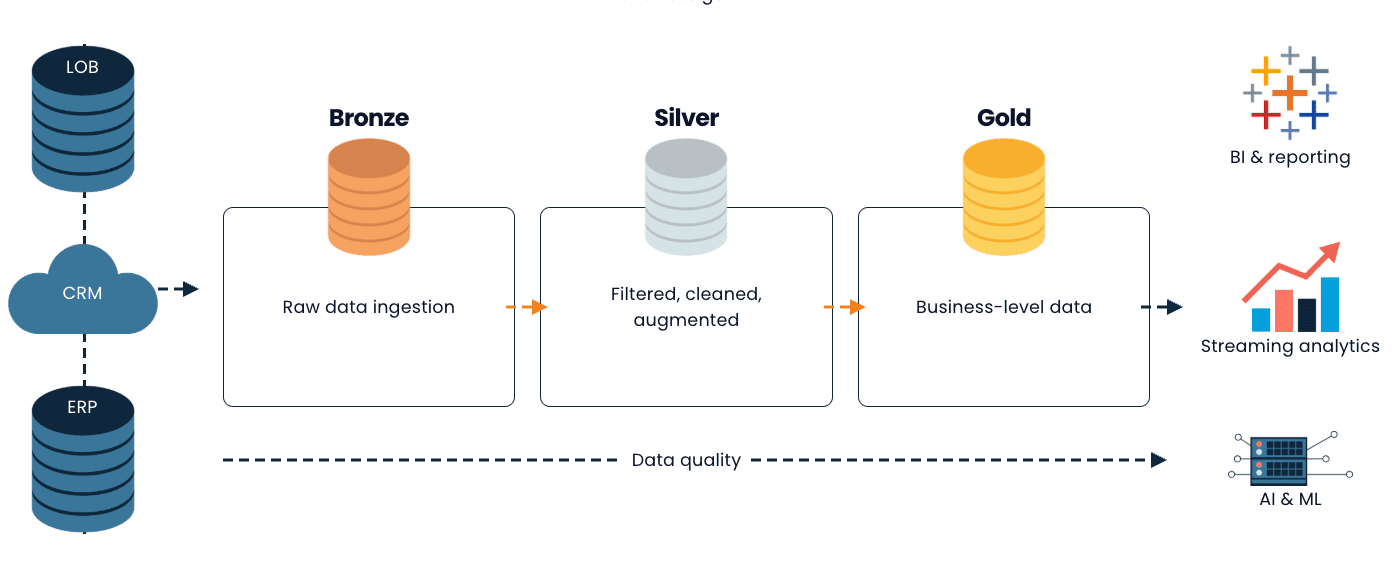
If your organization is building (or modernizing) a lakehouse, one of the first questions you’ll run into is: how do we keep data usable as it grows without turning the lake into a swamp? That’s where Medallion Architecture comes in. It’s a practical design blueprint for organizing data in layers, making it more trustworthy, reusable, and easier to consume as it moves downstream from raw ingestion to analytics-ready datasets.
At XeoMatrix, we like Medallion Architecture because it gives teams a clear, repeatable way to incrementally improve data quality and governance, without forcing everything into a single “perfect” model on day one.
What Is Medallion Architecture?
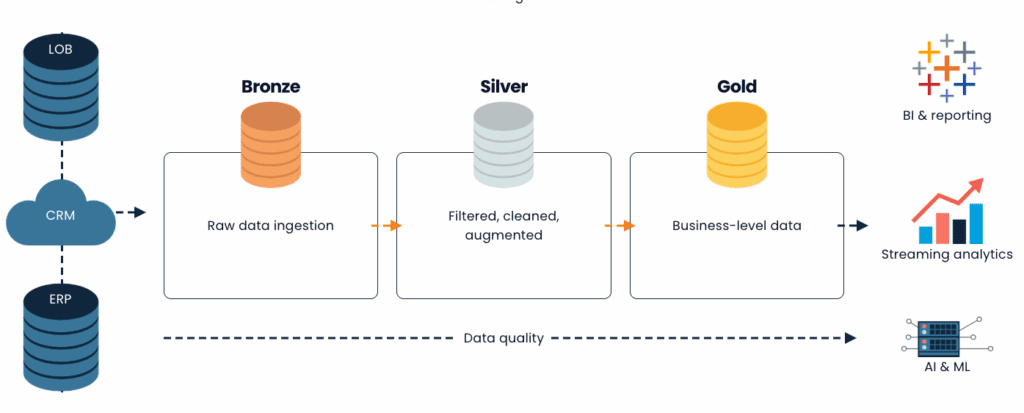
A Medallion Architecture organizes data into progressive layers, typically Bronze, Silver, and Gold, where each layer represents a higher level of refinement and readiness for downstream use.
The core idea is simple:
- Bronze is raw and traceable.
- Silver is cleaned and conformed (just enough).
- Gold is optimized for reporting, analytics, and business use cases.
This layered approach supports strong data lineage, auditing, reprocessing, and a smoother path to governance and compliance as your ecosystem evolves.
Bronze Layer: Raw Data Ingestion (Your Source of Truth)
The Bronze layer is the landing zone for data from external systems: databases, SaaS tools, APIs, logs, files, and streaming pipelines, you name it.
What belongs here
- Raw data captured “as-is” from source systems.
- Data structures that closely mirror source tables.
- Added metadata like load timestamps, batch/process IDs, source identifiers.
Why it matters
The Bronze layer is designed for Change Data Capture (CDC) and historical retention. It’s the place you go when you need to:
- Preserve the original record of what was received.
- Maintain lineage and audit trails.
- Reprocess downstream layers without re-reading source systems.
- Debug data issues by tracing transformations back to raw inputs.
Silver Layer: “Just-Enough” Transformation for an Enterprise View
The Silver layer is the next stage of the lakehouse. This is where data from the Bronze layer is transformed into a “just-enough” state, cleaned, standardized, and made consistent enough to support a broader enterprise view of key business entities, concepts, and transactions.
What belongs here
- Data that has been cleansed, verified, conformed, and matched so it’s meaningful and integrable.
- Tables/datasets that may still resemble source schemas, but are now consistent and consolidable.
- Outputs that other teams can reuse (analytics, data science, AI/ML, etc.).
Why it matters
The Silver layer is where you create a foundation that teams can trust and reuse, without doing so much transformation that you end up duplicating logic or overengineering the middle layer. The goal is to make the data ready to serve in Gold, where heavier modeling and reporting-focused transformations belong
Typical “just-enough” Silver transformations
- Data cleansing: remove duplicates, correct errors/typos, standardize formats (especially dates/addresses), and handle missing values.
- Data verification: validate quality against governance rules, resolve inconsistencies with business logic, standardize/normalize, and handle outliers.
- Data conforming: enforce agreed standards/formats so data from different sources can work together.
- Data matching for integration: align records across systems and often generate universal keys to consolidate datasets.
Gold Layer: Business-Ready Data for Analytics and Reporting
The Gold layer is where data becomes consumption-ready. It’s structured for specific use cases and optimized for performance, especially for BI dashboards, reporting, and executive-level metrics.
What belongs here
- Denormalized, read-optimized models.
- Aggregations, KPIs, business metrics.
- Subject-area data marts.
- Often Kimball-style star schemas (facts and dimensions).
Why it matters
Gold is designed for:
- Fast queries and minimal joins.
- Consistent reporting logic.
- Reliable metrics that stakeholders can trust.
- Supporting downstream BI tools (Tableau, Power BI, etc.).
A Key Point: Medallion Architecture Is a Pattern, Not a Data Model
One of the most important clarifications: Medallion Architecture is a design pattern for data organization, not a single modeling methodology.
It’s not inherently:
- Dimensional
- Relational
- Data vault
- NoSQL
A medallion-based system can include any of these approaches across different layers and can work with data lakes, warehouses, and lakehouse platforms.
In many real-world setups:
- Bronze lives in a data lake (raw + metadata).
- Silver also lives in the lake (flexible modeling, wide variety of schemas).
- Gold often lives in a warehouse (dimensional marts), but it can also be in the lake.
And yes, some organizations even implement medallion across multi-cloud platforms, where Bronze and Silver might live in different clouds than Gold, depending on tooling, governance, and consumption needs.
Medallion Architecture Everyday Example
An easy everyday example is online shopping orders.
- Bronze (raw): You ingest raw exports/streams from Shopify (orders), Stripe (payments), and ShipStation (shipments) exactly as they come in, same columns as the source, plus metadata like load time and source system.
- Silver (just-enough): You clean and standardize those feeds so they can be used together:
- Standardize dates/time zones and currency formats.
- Remove duplicates (e.g., re-sent webhook events).
- Fix missing values (e.g., unknown shipping method).
- Conform fields (e.g., “US”, “USA”, “United States” → “US”).
- Match customers/orders across systems (e.g., Shopify order ID ↔ Stripe charge metadata ↔ shipment tracking records) and create a consistent key.
- Gold (business-ready): You publish a reporting-friendly dataset like Daily Sales & Fulfillment with metrics such as total revenue, refunds, average order value, on-time shipping rate, and sales by product/category, ready for dashboards in Tableau (or other BI tools).
Why Organizations Use Medallion Architecture
When Medallion Architecture is implemented well, it becomes more than “data layering.” It becomes a foundation for long-term scale and trust.
1) Better data quality without a big-bang rebuild
By improving data gradually across layers, teams can deliver value early while continuously strengthening quality.
2) Reusability and maintainability
Silver provides a reusable enterprise view, so teams don’t have to rebuild the same logic in every downstream report or model.
3) Stronger governance and compliance
Layer boundaries make it easier to define:
- Who can access what.
- Where sensitive logic and rules live.
- How metadata and lineage are tracked.
4) Clear lineage and auditability
Because each stage is structured, it’s easier to trace:
- Where the data came from.
- What changed.
- Why downstream outputs look the way they do.
5) Better alignment with analytics and BI performance
Gold encourages read-optimized structures, reducing downstream complexity and improving decision-making reliability.
When Medallion Architecture Is a Great Fit
Medallion is especially helpful when you’re dealing with:
- Large volumes of data from multiple sources (terabytes/petabytes, high velocity, or lots of systems).
- High governance requirements (healthcare, finance, regulated industries).
- Advanced analytics and ML use cases that require consistent, high-quality features and training datasets.
- A growing data ecosystem, where you need a structure that can evolve without breaking everything.
How XeoMatrix Helps
Whether you’re modernizing a warehouse, moving toward a lakehouse, or trying to make data pipelines more reusable, Medallion Architecture can be a practical framework—especially when paired with the right governance and modeling decisions.
XeoMatrix helps teams:
- Design layer boundaries that match real business needs.
- Implement ingestion and transformation patterns that scale.
- Create Gold-layer models optimized for Tableau and stakeholder consumption.
- Improve lineage, reliability, and long-term maintainability.
If you want to pressure-test a medallion approach for your environment, contact us to talk through what ‘Bronze/Silver/Gold’ should mean for your data ecosystem.