Every Tableau Conference has its visible themes.
New features. Big demos. Exciting announcements. Roadmaps. Buzzwords.
Somewhere between keynote applause, technical sessions, hallway conversations, and community reactions, a quieter theme began to emerge.
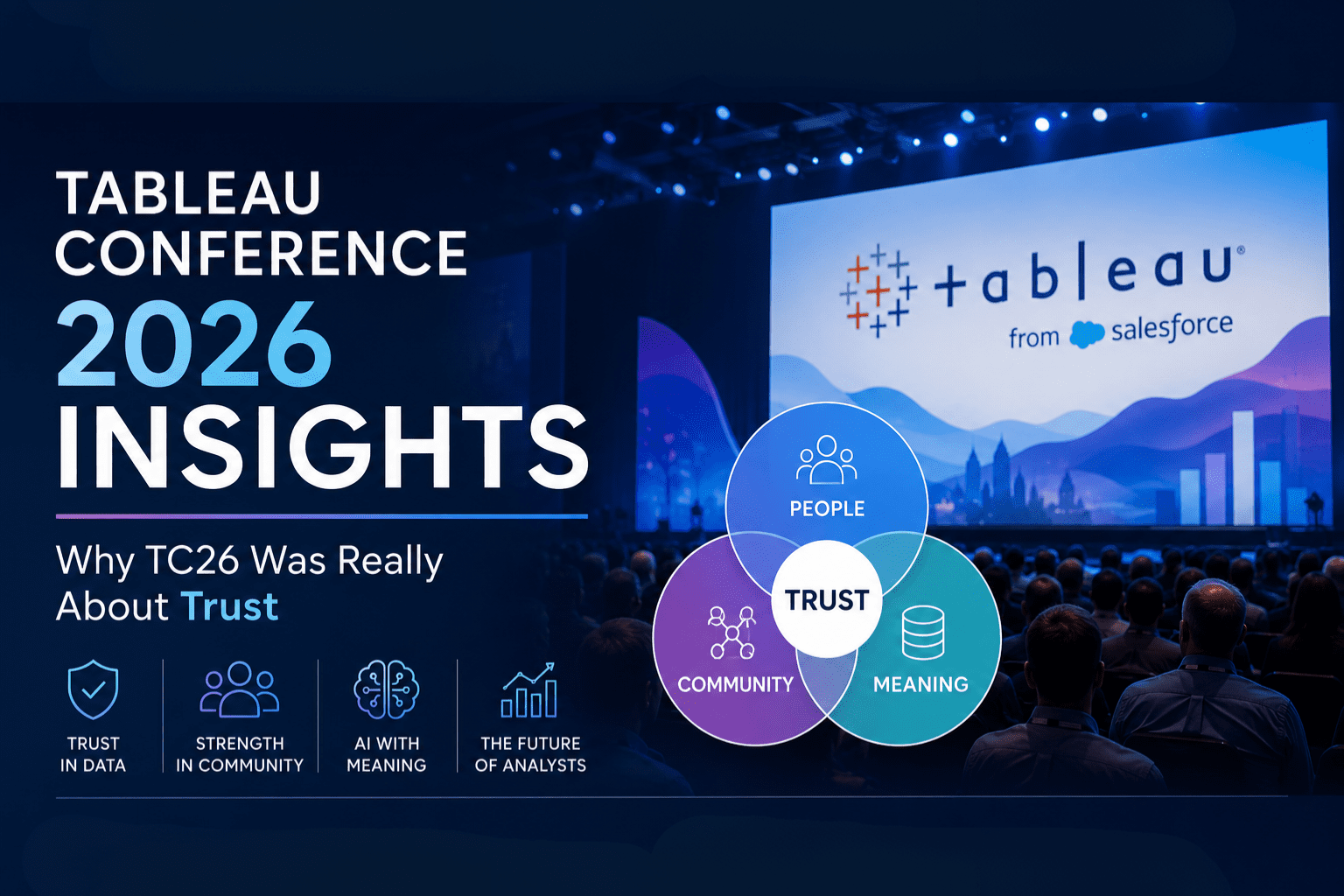
For me, that theme at TC26 was trust.
Not just trust in AI, though there was plenty of discussion around that. But rather…
Trust in leadership.
Trust in community.
Trust in meaning.
Trust for what the role of the analyst becomes next.
AI Has Raised the Stakes for Meaning
One of the clearest messages throughout TC26 was the growing priority on semantics.
Semantic layers. Business context. Governed definitions. Trusted metrics. Grounded AI responses.
At first glance, this may feel new because it is now attached to conversational analytics and agentic workflows. But in reality, the industry is rediscovering something it has wrestled with for decades:
Data without shared meaning is fragile.
For years, many organizations prioritized speed and access. Dashboards became easier to build, data became easier to connect to, and self-service analytics expanded rapidly.
Humans are remarkably good at compensating for ambiguity. We learn organizational nuance, infer intent, and ask follow-up questions naturally. AI systems cannot reliably do that without structure.
That changes the role of semantics entirely.
What was once viewed as “governance work” or “metadata management” is increasingly becoming foundational infrastructure for trustworthy AI-enabled analytics.
TC26 reflected this shift.
The conversations around semantic data models were not about documentation for documentation’s sake. They were about enabling systems to understand business meaning consistently enough to produce reliable outcomes.
AI did not invent the need for semantics. It made semantics unavoidable.
Tableau Is Entering a New Era
The introduction and visibility of Tableau’s new GM and EVP carried significance beyond organizational structure. Leadership transitions always shape tone and direction, especially during periods of platform evolution.
And Tableau is evolving rapidly.
The company now sits at the intersection of traditional visual analytics, enterprise governance, semantic modeling, Salesforce platform strategy, and AI-enabled workflows.
That is a difficult balancing act.
Many longtime conference attendees still associate Tableau with independent exploration, creativity, and visual storytelling. At the same time, the broader market is pushing toward interoperability, enterprise trust, and operational AI systems.
TC26 felt like an attempt to bring those worlds together.
Not by abandoning Tableau’s roots, but by reframing them for a different technological moment.
Visualization still matters. Curiosity still matters. Human insight still matters.
But increasingly, the conversation is shifting toward how organizations establish trustworthy context before insights are generated.
That is a meaningful evolution.
The DataFam Moment
One of the most discussed moments after the keynote was not a product demo.
It was a community moment.
During the keynote, attendees connected to the Tableau community were invited to stand as part of a recognition of the DataFam. But something unexpected happened. Many people remained seated, unsure whether the invitation applied to them. Ambassadors and Visionaries promptly stood, while others hesitated.
The moment itself was brief. But the reaction afterward was telling.
Almost immediately, conversations across social media began reinforcing the idea:
“We All Are DataFam.”
I noted the response because it revealed something deeper about the Tableau community.
The DataFam has always been more than a marketing term. For most people, it represents generosity, mentorship, shared learning, encouragement, and professional belonging. It has helped people change careers, build friendships, find confidence, and discover opportunities they never expected.
But meanings evolve, and sometimes they drift.
Over time, visible leadership groups like Ambassadors, Visionaries, and DataDev Ambassadors naturally became symbolic representations of community participation. The keynote moment unintentionally exposed some ambiguity between “recognized community leaders” and the broader community itself.
What stood out most was not the hesitation itself, but how quickly the community responded afterward.
The overwhelming response was not exclusion. It was inclusion.
“We are ALL DataFam” became the declaration.
Honestly, that may have been one of the most important moments of the conference.
The Analyst Role Is Changing Again
Another underlying theme beginning with the keynote and following sessions was the evolving role of the analyst.
As conversational analytics and AI-assisted workflows mature, there is growing discussion around what becomes more valuable when systems can generate dashboards, summaries, and even recommendations automatically.
I don’t believe the analyst disappears.
But I do think the emphasis changes.
The future analyst may spend less time manually assembling charts and more time defining business meaning, validating outputs, structuring trusted context, communicating nuance, and guiding organizations through ambiguity.
In other words, the human role shifts upward.
Not away from analytics, but deeper into judgment, interpretation, and trust stewardship.
Ironically, the rise of AI may make human clarity even more important.
TC26 Was Really About Trust
Looking back, TC26 wasn’t fundamentally about features.
It was about preparing for an era where trust becomes the central requirement of analytics.
Trust in the people interpreting and applying the results.
Trust in the people willing to guide others through ambiguity.
And that may ultimately be the most important lesson from TC26:
Not just data. Meaning. And that’s where the Analyst comes in.
But the Analyst is not alone, and the DataFam knows that.
Next time, we’ll all stand together.